Selected by the CP design and project specification.
Buried structure protection
Prepackaged Magnesium Anodes
Send the model or weight, cable, backfill and quantity directly. No form required. Email: sales@cathprocp.com
CathPro prepackaged magnesium anodes, including HP17D3 and HP32D5, combine an ASTM B843 high potential or standard potential magnesium anode with cable, backfill and cotton bag, ready to bury for pipeline and tank-bottom cathodic protection, manufactured in Jiaozuo, China by CathPro (Jiaozuo Huayu Magnesium Co., Ltd.). Quotes: sales@cathprocp.com.
A prepackaged magnesium anode is a complete buried-service assembly, not only a casting. The magnesium body, steel core, cable joint, environmental seal, prepared backfill and outer bag must work as one controlled product.
CathPro supplies high-potential and standard-potential configurations for pipelines, tank bottoms and other buried steel structures. Final model selection, quantity and spacing remain part of the cathodic protection design.
Technical pageStandards mapped by scopeData fields stated explicitly
Potential and capacity testing can be defined in the ITP.
Anode, core, cable, backfill and bag are checked together.
Model selection & quotation
Find your HP model. Send your project requirements.
Compare the nominal models below. For a quotation, send the model or drawing, quantity and delivery destination by WhatsApp or email.
| Model | Anode W x H x L | Net alloy mass | Typical package dia. x L | Request this model |
|---|---|---|---|---|
| HP 3D3 | 89 x 95 x 127 mm | 1.4 kg | 152 x 254 mm | |
| HP 9D3 | 89 x 95 x 356 mm | 4.1 kg | 152 x 432 mm | |
| HP 17D3 | 89 x 95 x 654 mm | 7.7 kg | 191 x 864 mm | |
| HP 32D5 | 140 x 127 x 521 mm | 14.5 kg | 203 x 711 mm | |
| HP 48D5 | 140 x 146 x 787 mm | 21.8 kg | 203 x 965 mm | |
| HP 4x4x60 | 102 x 102 x 1,524 mm | 27.2 kg | 178 x 1,626 mm |
Dimensions and net alloy masses are retained from the published CathPro datasheet. Gross packaged mass depends on the approved backfill and bag specification. Model selection, quantity and spacing remain part of the project CP design.
Technical files
Published product datasheets
High-potential magnesium anode datasheetControlled public summary of alloy, electrochemical, assembly and inspection fields. Standard-potential magnesium anode datasheetControlled public summary for standard-potential bare and prepackaged supply.Have a different size or an incomplete specification?
Send the drawing or the requirements you already have. Add cable size and length, backfill, quantity and delivery destination if specified. No form is required.
Product overview
Prepackaged anode assemblies for buried cathodic protection
Compare HP 17D3, HP 32D5 and other magnesium anode models for prepackaged cathodic protection assemblies. Each package combines the anode body and core, cable connection, prepared backfill and bag; cable size and length, backfill and quantity are confirmed for your project.
- Primary function
- Provide galvanic current to buried steel where magnesium driving voltage is required.
- Typical services
- Buried oil, gas and water pipelines; underground tanks; plant piping; temporary CP.
- Selection inputs
- Soil resistivity, coating condition, current demand, design life, alloy family and installation geometry.
- Supply boundary
- Bare anode body or complete prepackaged assembly, as defined in the approved product datasheet.
Product construction
What the finished product contains
Each interface is specified because a correct alloy can still underperform if the cable connection, seal, backfill or package is poorly controlled.
Magnesium anode body
Cast high-potential M1C-type or project-selected standard-potential alloy, with net mass and dimensions controlled by model or drawing.
Steel core or insert
Central core or connection insert sized and positioned to provide mechanical support and a stable electrical interface.
Cable connection and seal
Project-selected conductor and insulation joined to the core, checked for continuity and protected against moisture entry and handling damage.
Prepared backfill
Uniform contact medium around the anode. A commonly specified prepackaged backfill is 75% gypsum, 20% bentonite and 5% sodium sulfate by mass; the approved purchase specification always controls. ASTM G97 is a laboratory evaluation method, not a complete package specification.
Outer containment and identification
Cotton or project-specified bag with controlled fill mass, closure, anode model, cable length, batch and project marking.
Premium product studies
Products, configurations and critical interfaces
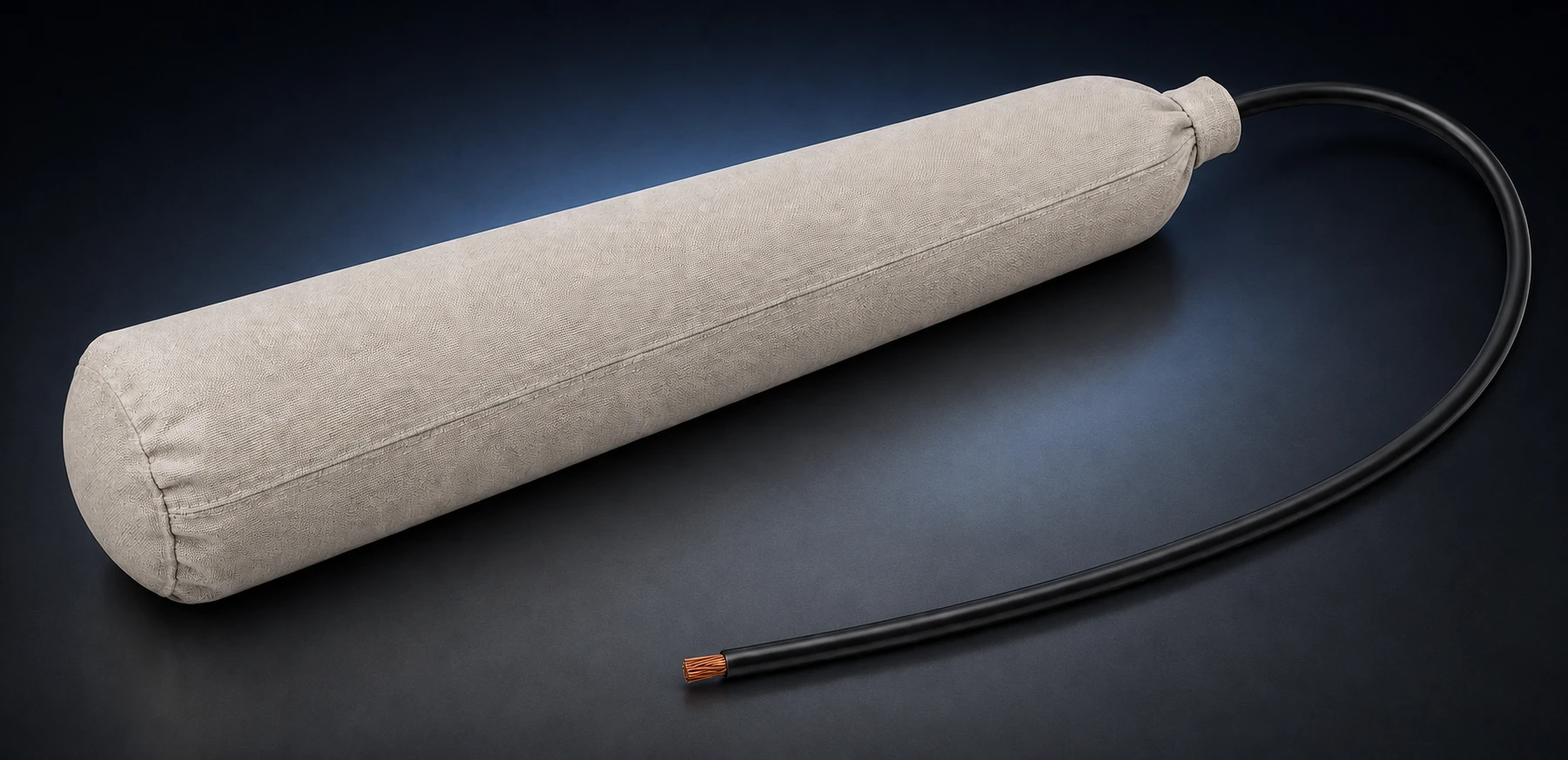
Premium studio product studies show the complete prepackaged assembly and representative magnesium-body and steel-core configurations. They are product visualizations; alloy grade, dimensions, core arrangement and order-specific inspection evidence remain controlled by the approved datasheet, drawing and ITP.
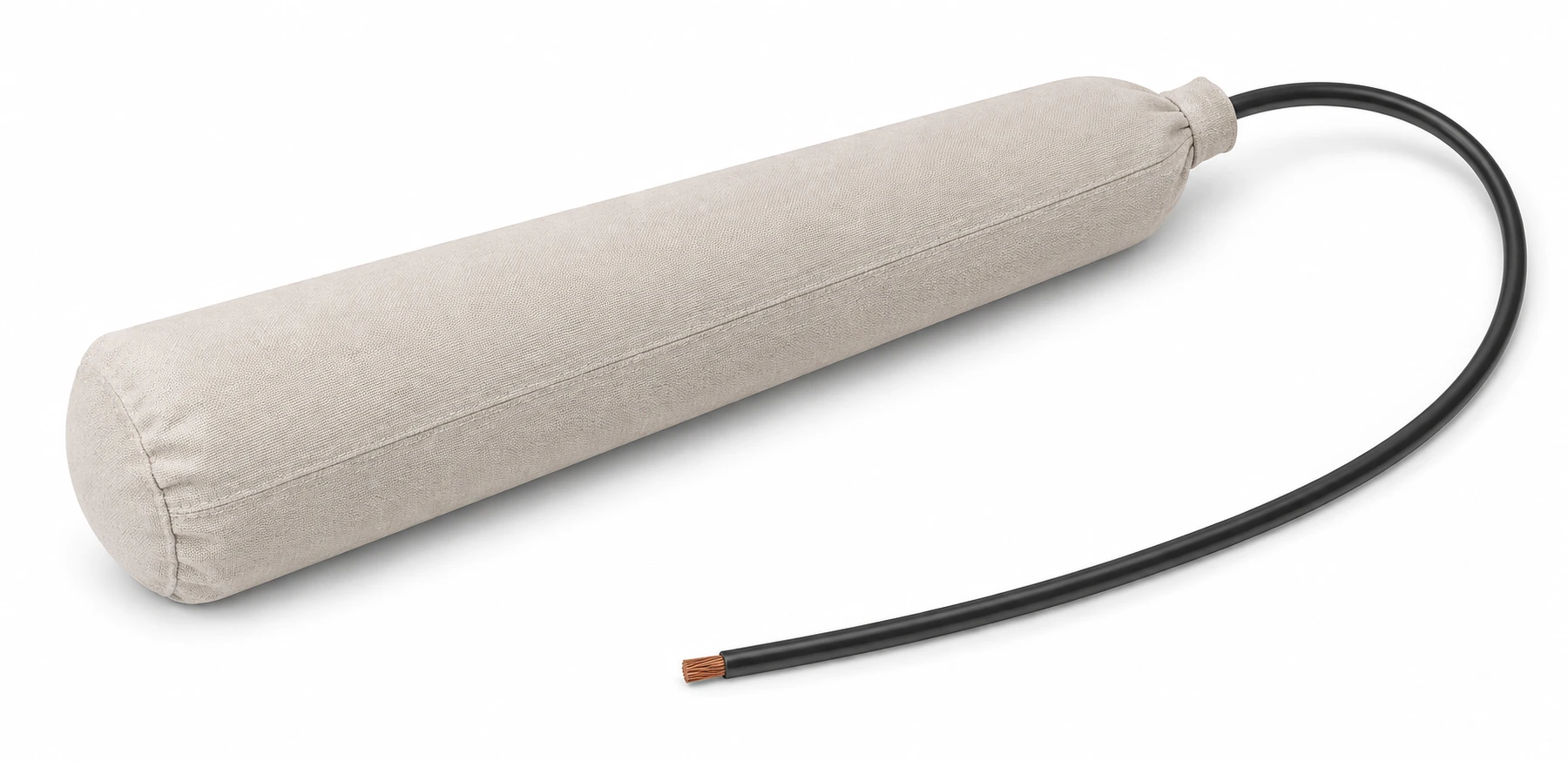
Anode, prepared backfill, bag and cable shown as one supply item
The complete package is released from one assembly datasheet covering alloy, core, lead, joint, backfill, bag and marking.
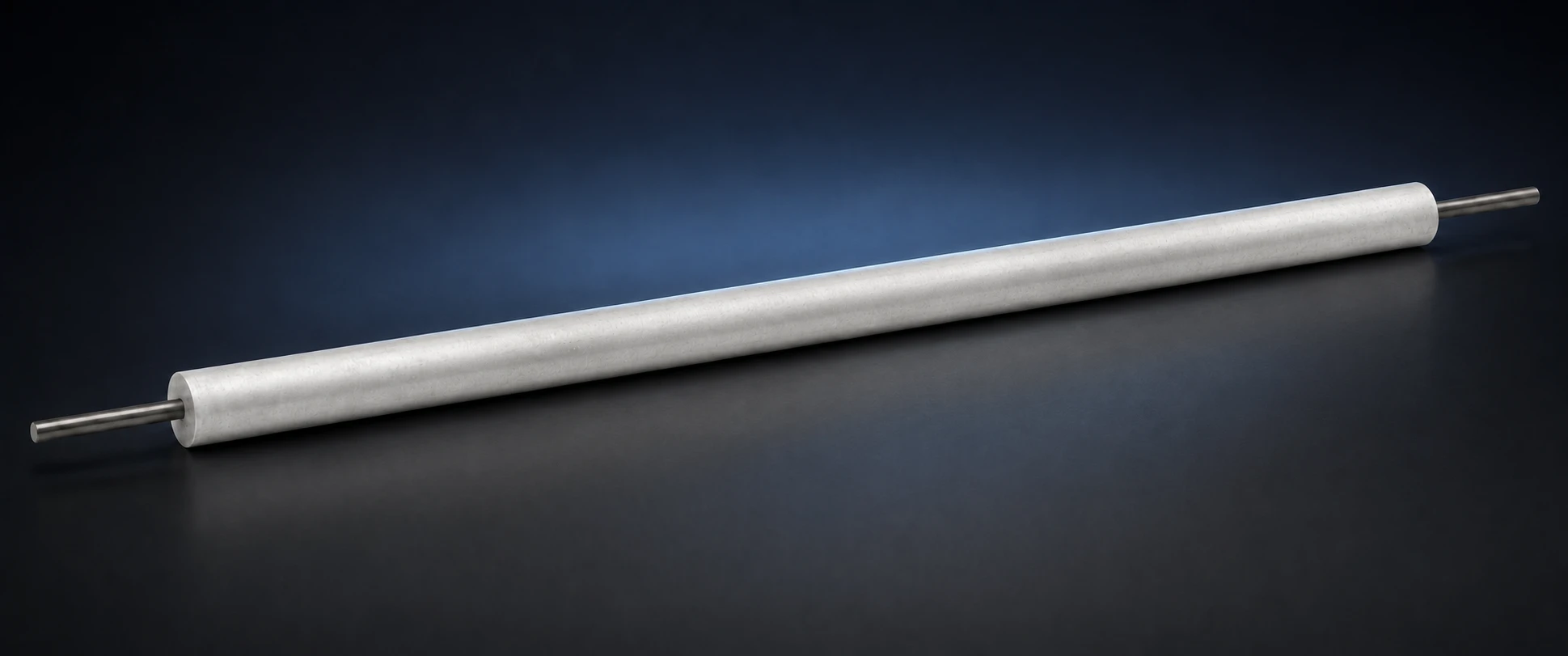
Body length, diameter and core path remain drawing-controlled
The image explains a representative casting form. Alloy grade, net mass, core section, projections and tolerances must be stated on the approved drawing.
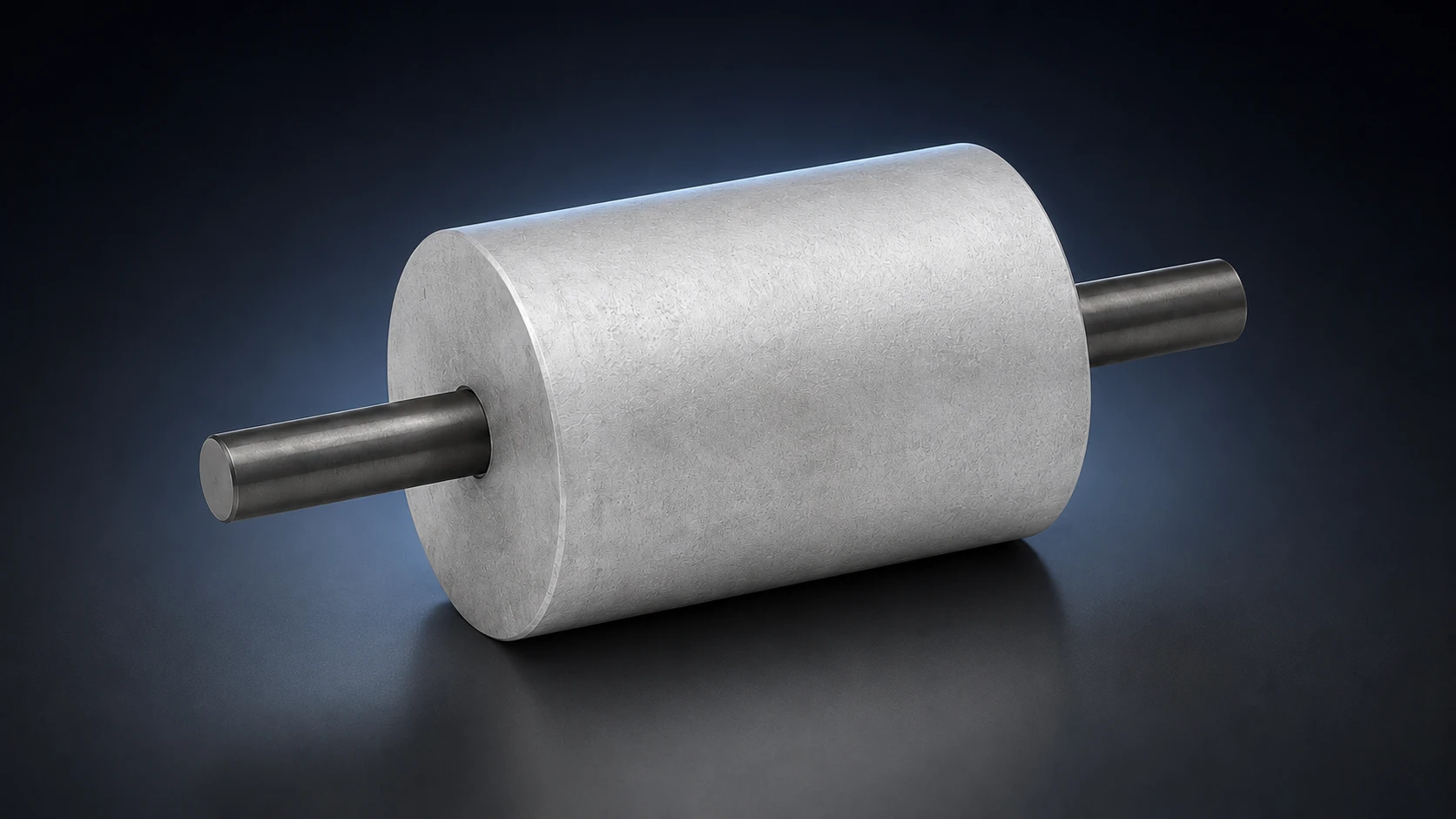
Short-body geometry reviewed together with the steel core
A compact casting is not a universal model. Net alloy mass, diameter, length, core material and intended assembly are confirmed for the order.
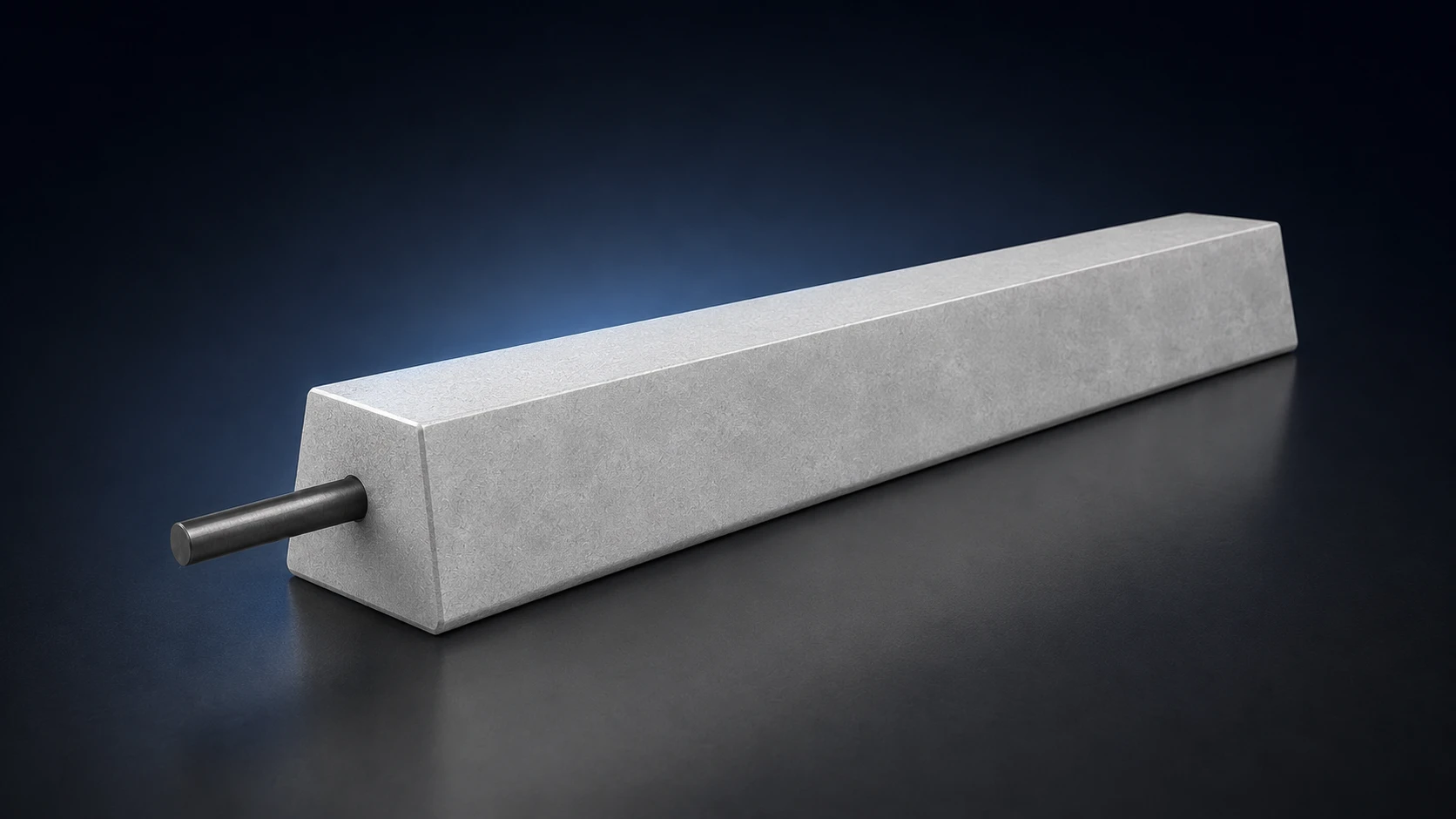
Casting profile and visible core interface shown clearly
The product study supports geometry review only; exact alloy, core arrangement, dimensions and electrochemical acceptance criteria remain specification-controlled.
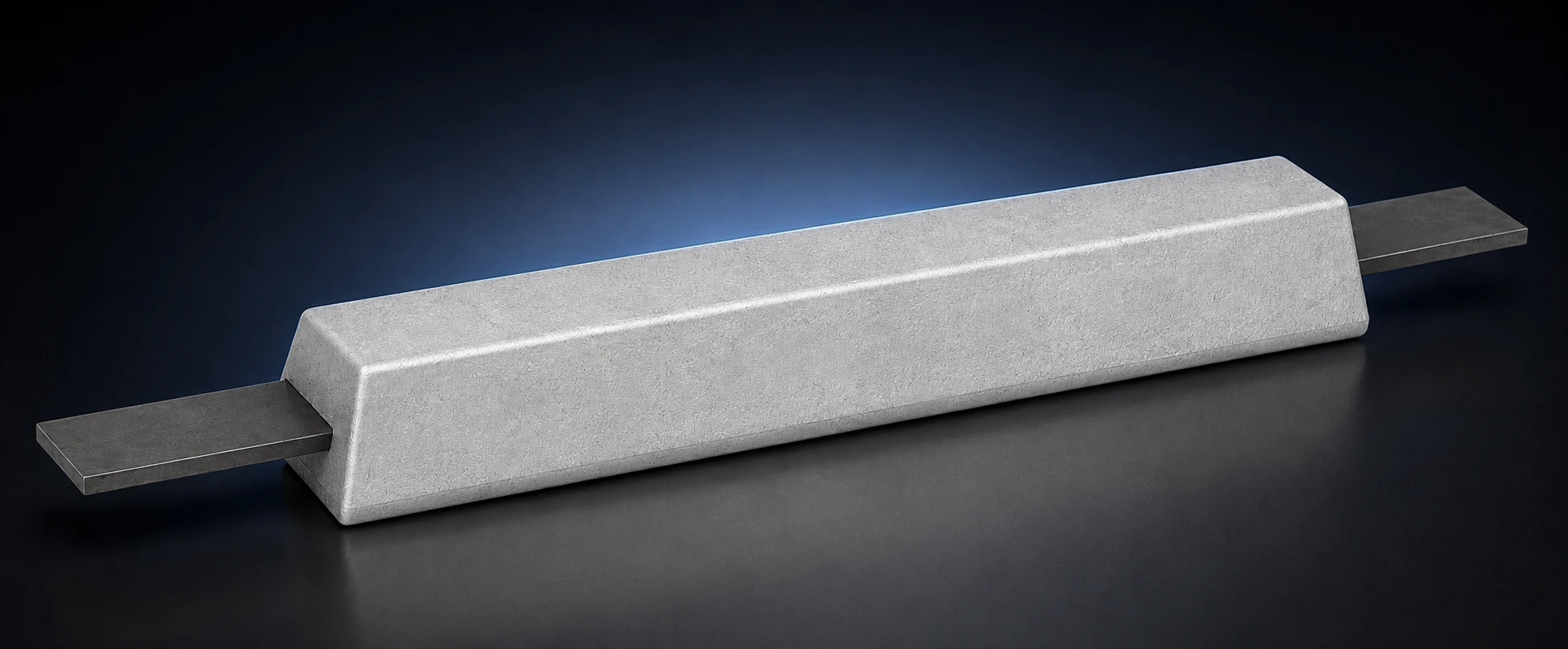
Flat steel inserts prepared for a drawing-defined mounting interface
Insert section, projection, weld details, casting envelope and net alloy mass are released together against the approved drawing and inspection plan.
Product families
Configurations covered by this product range
Each configuration is released against its own datasheet, drawing or component schedule. Similar appearance does not make the technical definitions interchangeable.
High-potential assembly
High driving voltage for designs that specify ASTM B843 M1C-type chemistry and ASTM G97 performance verification.
Standard-potential assembly
AZ63/H-1-type or other project-selected alloy for designs where standard magnesium potential is appropriate.
Bare cast anode
Anode body and core supplied without backfill when the site or project scope defines separate assembly work.
Drawing-based assembly
Custom net mass, D-shape or other casting, cable lead, bag dimensions and labeling controlled by an approved drawing.
Applicable standards
Standards mapped to the part they actually control
Listing a standard is not a certification claim. The purchase specification must identify the required edition, clauses, tests and evidence. Project documents take precedence where they add or modify requirements.
| Standard and role | Scope | How it applies to this product |
|---|---|---|
| ASTM B843-18(2025)Product specification | Magnesium alloy anodes in cast and extruded forms for cathodic protection. | Alloy designation, chemical composition, sampling and finished-anode condition. The standard is prescriptive, not a field-performance guarantee. |
| ASTM G97-18(2022)Laboratory test method | Laboratory evaluation of magnesium sacrificial-anode specimens for underground applications. | Electrode potential and ampere-hours per unit mass under the stated test electrolyte and procedure. Field performance can differ. |
| GB/T 17731-2015Chinese product standard | Magnesium-alloy sacrificial anodes, including product classification, technical requirements and inspection. | Use the applicable alloy designation, edition and order requirements. Cable, backfill and outer bag remain separately controlled for prepackaged assemblies. |
| GB/T 24488-2021Chinese test method | Electrochemical performance testing of magnesium-alloy sacrificial anodes. | Potential, capacity and efficiency results must identify the test method, electrolyte, reference electrode, duration and sample basis. |
| ISO 15589-1:2026CP system standard | Cathodic protection of on-land pipeline transportation systems, covering design, materials, equipment, installation and inspection. | The system designer's requirements for anodes, monitoring points, cabling, equipment and commissioning. It is not a standalone manufacturing certificate for every component. |
| NACE SP0169-2024Corrosion-control practice | Control of external corrosion on underground or submerged metallic piping systems. | CP criteria, design and installation context. Product configuration still follows the purchase specification and approved drawings. |
Edition review completed 22 July 2026. The edition named in the project requisition or purchase order remains the contractual basis.
Technical Data Sheet
Parameters buyers and engineers can verify
Numeric values are shown only where a current CathPro datasheet or recognized reference supports them. Custom assemblies use explicit project-defined fields instead of invented catalogue values.
Electrochemical acceptance fields
Public data deliberately separates a test method from order-specific acceptance values. Values are released only through the approved datasheet and ITP for the selected alloy grade.
| Property | What must be stated | Control basis |
|---|---|---|
| Alloy designation | Exact ASTM B843, GB/T 17731 or project grade | Approved purchase specification |
| Open-circuit potential | Value/range, reference electrode, electrolyte and temperature | ASTM G97, GB/T 24488 or agreed method |
| Closed-circuit potential | Value/range, reference electrode, electrolyte and test duration | Approved test procedure and ITP |
| Current capacity | Acceptance value with units and complete specimen/test basis | Approved order datasheet; not a field-life guarantee |
| Current efficiency | Acceptance value and calculation method when required | Approved ITP and laboratory report |
CathPro does not publish an unsupported universal potential, capacity or efficiency value for every magnesium alloy and assembly.
Magnesium alloy chemistry control summary
ASTM and GB/T standards are identified by designation and scope without reproducing their copyrighted composition tables. The approved order sheet states the exact grade and applicable limits.
| Control field | What is identified | Evidence |
|---|---|---|
| Alloy grade | Exact designation and applicable standard edition | Approved datasheet/purchase order |
| Controlled additions | Grade-specific elements such as manganese, aluminum or zinc where applicable | Heat/sample analysis |
| Restricted impurities | Grade-specific limits for iron, nickel, copper, silicon and other stated impurities | Laboratory chemistry report |
| Base metal | Magnesium remainder subject to the selected grade | Analysis and material identity |
| Sampling | Heat, lot or agreed production-sample frequency | Approved ITP |
Compare HP models · Download datasheets
Complete assembly datasheet fields
These fields define the manufactured item and should appear together on the approved product datasheet or drawing.
| Data block | Parameters controlled | Typical evidence |
|---|---|---|
| Anode body | Alloy, model, net mass, dimensions, tolerances, core | Approved drawing and chemistry report |
| Cable | Conductor size, insulation, color, length, end preparation | Cable specification and continuity record |
| Connection | Joint method, mechanical security, seal system | Assembly instruction and inspection record |
| Backfill | Composition, dry mass, uniformity and moisture condition | Batch or filling record as agreed |
| Bag and marking | Material, size, closure, model, project tag, batch | Final visual and packing record |
Manufacturing control
From approved data to an inspectable product
The process is organized around released drawings, material identity, controlled interfaces and inspection records. No unapproved change is treated as equivalent by default.
Material release
Review alloy designation and melt chemistry against the approved specification before the heat is released.
Core and mold preparation
Verify core geometry, location, cleanliness and mold dimensions against the controlled drawing.
Casting and finishing
Cast the anode body, remove gates and risers, and inspect surface condition without concealing unacceptable defects.
Cable joint assembly
Make the electrical connection using the approved method, then apply the specified environmental seal and mechanical protection.
Continuity and dimensional checks
Confirm cable continuity, polarity, lead length, anode dimensions and net alloy mass.
Backfill and bagging
Control formulation, fill mass, central positioning, bag condition and closure for the complete assembly.
Final identification
Apply model, project and batch identification before palletizing to protect the cable and bag during export handling.
Inspection and test plan
Checks tied to a stated acceptance basis
Inspection is useful only when the method, acceptance document and product identity are recorded together.
| Inspection item | Method or record | Acceptance basis |
|---|---|---|
| Chemical composition | Spectrometric or agreed chemical analysis by heat/sampling plan | ASTM B843 grade or approved project limits |
| Potential and capacity | ASTM G97 laboratory test when included | Approved ITP acceptance values and test conditions |
| Dimensions and mass | Calibrated dimensional and weighing equipment | Approved drawing and stated tolerances |
| Cable and connection | Conductor/lead-length check, continuity and connection inspection | Cable schedule and assembly procedure |
| Backfill and package | Composition/fill record, bag closure, marking and visual check | Approved assembly datasheet and packing plan |
Application range
Where this product family is used
- Buried transmission pipelines
- Water pipelines
- Underground storage tanks
- Gas distribution networks
- Buried plant piping
- Well casings
- Temporary CP systems
- Retrofit and maintenance projects
Engineering selection notes
Points that should remain visible in technical review
- Do not select an anode only by net weight; alloy potential, soil resistivity, current demand and design life determine the required system.
- Cable insulation and connection sealing must match the burial environment and installation handling method.
- The backfill formulation shown in ASTM G97 is a common reference, not an automatic substitute for the project specification.
Documentation
Evidence that follows the manufactured item
The final document set is defined by the order and ITP. Availability depends on the product, inspection scope and approved vendor-data requirements.
Approved product datasheet
Complete assembly definition including alloy, model, cable, connection, backfill, bag and marking.
Material and chemistry record
Heat or batch analysis linked to the finished item identification.
Inspection and test report
Dimensions, mass, appearance, cable checks and electrochemical testing when included in the ITP.
Packing record
Package count, net and gross mass, project tags and pallet arrangement.
Buying questions
Before you request a quotation
Practical information for procurement teams. Order-specific terms are confirmed in the quotation.
What information should I send for a quotation?
Send the model or drawing, quantity and delivery destination. Include the required alloy, cable specification, backfill, inspection requirements and requested delivery date when available. You can start with the information you already have.
Can I request a different size, cable or package?
Send the required dimensions or drawing, net alloy mass, cable and packaging details for technical review. The proposed configuration and supply scope must be confirmed in the quotation and approved drawing.
How do I confirm the minimum order, samples and lead time?
Include your required quantity and delivery date in the inquiry. Ask for the minimum order quantity, sample availability and lead time for that configuration; these are confirmed in the quotation, not implied by the catalogue.
Which packing and inspection documents should I request?
State the required packing, markings, material records, test reports and inspection scope with your inquiry. Document availability and any additional inspection requirements must be agreed for the order. Public datasheets are not a substitute for batch-specific test evidence.
Technical questions
Common specification points
Answers focus on product definition and evidence, not on sales instructions.
What is the difference between high- and standard-potential magnesium?
High-potential magnesium provides a more negative driving voltage. The CP designer selects the alloy family according to soil resistivity, coating condition, current demand and system constraints.
Does ASTM B843 define the complete prepackaged assembly?
No. ASTM B843 addresses magnesium alloy anodes, primarily chemistry and product condition. Cable, joint, backfill, bag, marking and assembly tests need to be defined by the project datasheet and drawings.
What does ASTM G97 verify?
It is a laboratory method for electrode potential and ampere-hours per unit mass of magnesium specimens in a defined electrolyte. It supports quality evaluation but does not duplicate every field condition.
Which records demonstrate assembly control?
A strong record set links chemistry, dimensions, mass, cable specification, continuity, connection inspection, backfill/bag checks and final identification to the same production batch.