Pipeline route, pipe network or tank plan, anode length and installation method: trench or directional drilling.
Conductive polymer linear anode | Pre-packaged in coke | Pipelines, networks and tank bottoms
Conductive Polymer Linear Anode
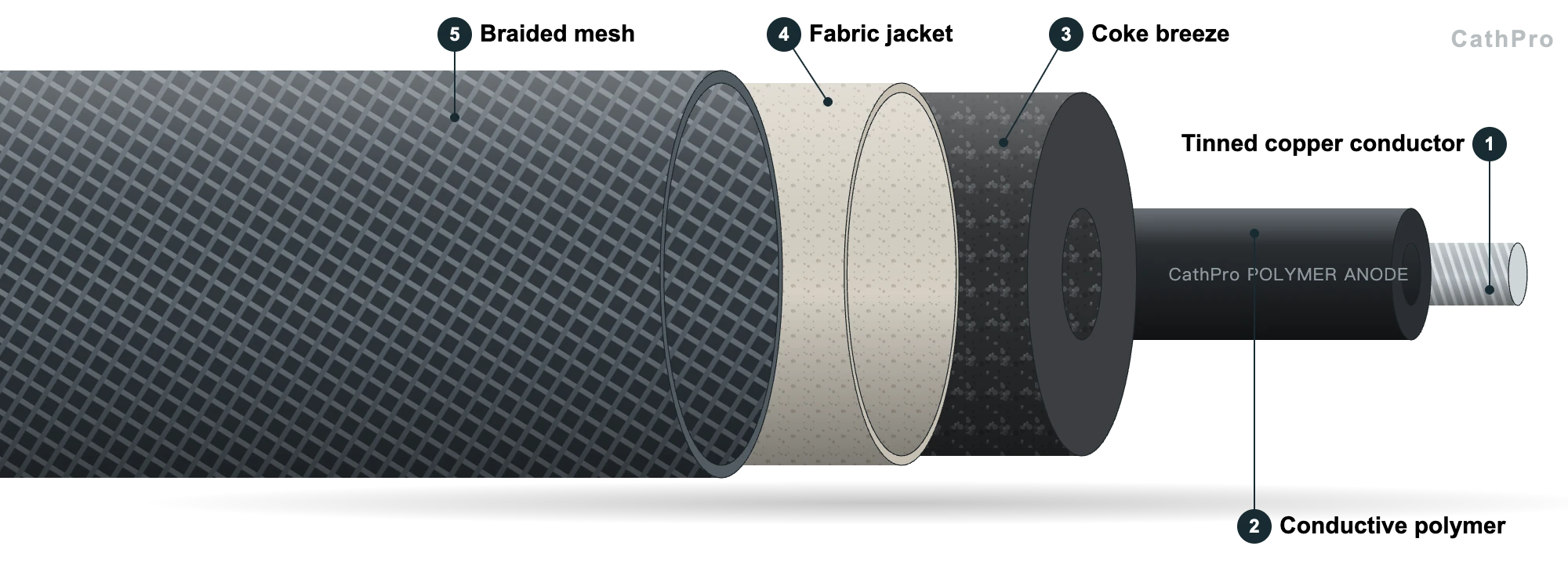
A continuous impressed-current anode with no nodes: carbon-loaded conductive polymer extruded over a 16 mm² tinned copper conductor, pre-packaged in calcined petroleum coke inside a fabric jacket and braided mesh. Send the route, current demand, soil data and design life for an order-specific offer.
- 16 mm² Tinned Copper (IEC 60228)
- 13 mm Conductive Polymer
- Up to 82 mA/m in Coke
- No Nodes Along the Run
Illustrations are schematic and not to scale. Final conductor, packaging, current rating, design life, reel lengths and inspection scope are controlled by the confirmed quotation and order documents.
Required current per metre against the maximum output of 52 mA/m bare or 82 mA/m in coke, for a 20-year design life.
Soil resistivity and chemistry; not for oily wastewater or saline water, where an MMO/Ti anode is preferred.
The complete current path
Current leaves the anode along its whole length.
The tinned copper conductor carries the current along the run with little voltage drop. The conductive polymer seals the copper and passes the current to the coke breeze, which takes over most of the electrochemical reaction and transfers the current to the soil and on to the protected steel.
Rectifier (+)
Positive Feeder
Tinned Cu Conductor
Conductive Polymer
Coke Breeze
Soil
Protected Steel (−)
With no wire-to-cable nodes, the anode is continuous from end to end. Laid parallel and close to the structure, it suits poorly coated pipelines, high-resistivity soil and complex pipe networks.
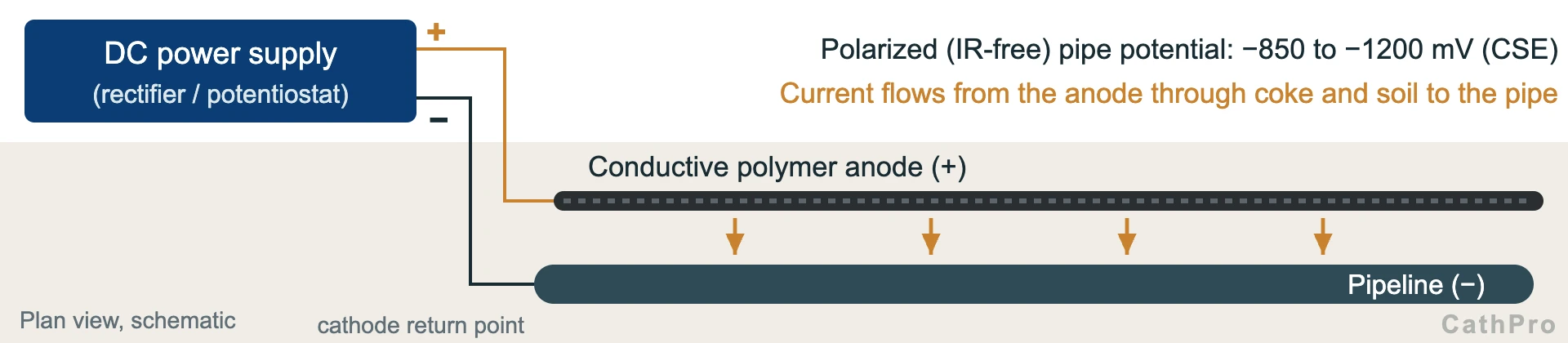
Working principle, plan view: the power supply drives current from the anode through coke and soil to the pipeline. Protection criterion: polarized (IR-free) potential −850 to −1200 mV (CSE). Schematic, not to scale.
Product specification
Technical data of the standard product.
Values from data sheet CP-DS-PA-001. The accepted quotation and the project data sheet govern each order; operating above the maximum output current shortens anode life.
| Parameter | Value |
|---|---|
| Copper conductor | 16 mm² tinned copper, class 2 stranded (IEC 60228) |
| Conductive polymer outer diameter | 13 mm |
| Maximum output current | 52 mA/m without backfill; 82 mA/m in coke backfill (pre-packaged) |
| Design life | 20 years at the maximum output current |
| Minimum bending radius | 150 mm bare anode; 500 mm recommended for the pre-packaged anode |
| Minimum installation temperature | −18 °C |
| Pre-packaged anode | Outer diameter approx. 38 mm, mass approx. 1.5 kg/m (coke breeze, fabric jacket and braid) |
| Reel lengths | Up to 500 m per reel; lengths to order |
| Lead cables | Per project, e.g. 1 × 16 mm² copper cable with HMWPE or PVDF/HMWPE insulation, 25 m at each end |
| Accessories | In-line joint kit, tee joint kit, end cap kit |
Five components, one continuous anode
What is inside the braided jacket.
The pre-packaged anode arrives ready to lay: no separate coke backfill on site, and no connections along the run.
1 · Tinned copper conductor
16 mm² tinned copper, class 2 stranded (IEC 60228); the low-resistance bus bar that carries current along the run.
2 · Conductive polymer
Carbon-loaded polymer extruded continuously over the conductor, 13 mm outer diameter; seals the copper and discharges current along the full length.
3 · Coke breeze
Pre-packaged calcined petroleum coke; takes over most of the electrochemical reaction, lowers the resistance to earth and extends anode life.
4 · Fabric jacket
Acid-resistant, permeable woven fabric holding the coke and keeping the conductor centred.
5 · Braided mesh
Non-conductive protective braid improving abrasion and damage resistance for trench or directional-drilling installation.
Polymer or MMO/Ti
Two flexible linear anodes, one choice per duty.
Both are flexible linear anodes for impressed current cathodic protection. They differ in the current-discharging element; see the MMO/Ti flexible linear anode for higher ratings and longer design lives.
| Item | Conductive polymer anode | MMO/Ti flexible anode |
|---|---|---|
| Discharging element | Conductive polymer over tinned copper | MMO-coated titanium wire |
| Connection to the cable | Continuous, no nodes | Nodes every ≤ 5 m |
| Output per metre | Max. 52 mA/m bare, 82 mA/m in coke | 26–104 mA/m, by wire size and design life |
| Design life | 20 years at maximum output | 25–50 years (rating table) |
| Breakpoint location | — | Available (FApro type) |
| Typical use | Poorly coated pipelines, high-resistivity soil, complex pipe networks, tank bottoms; not in oily wastewater or saline water | Station areas, higher current or longer life, tank bottoms, airport aprons |
Installation guidelines
Lay it slack, keep the separation, never drag it.
On receipt, check size, length, reel number and certificate; braid and fabric jacket must be intact, with no coke leakage. Keep reels standing on their flanges.
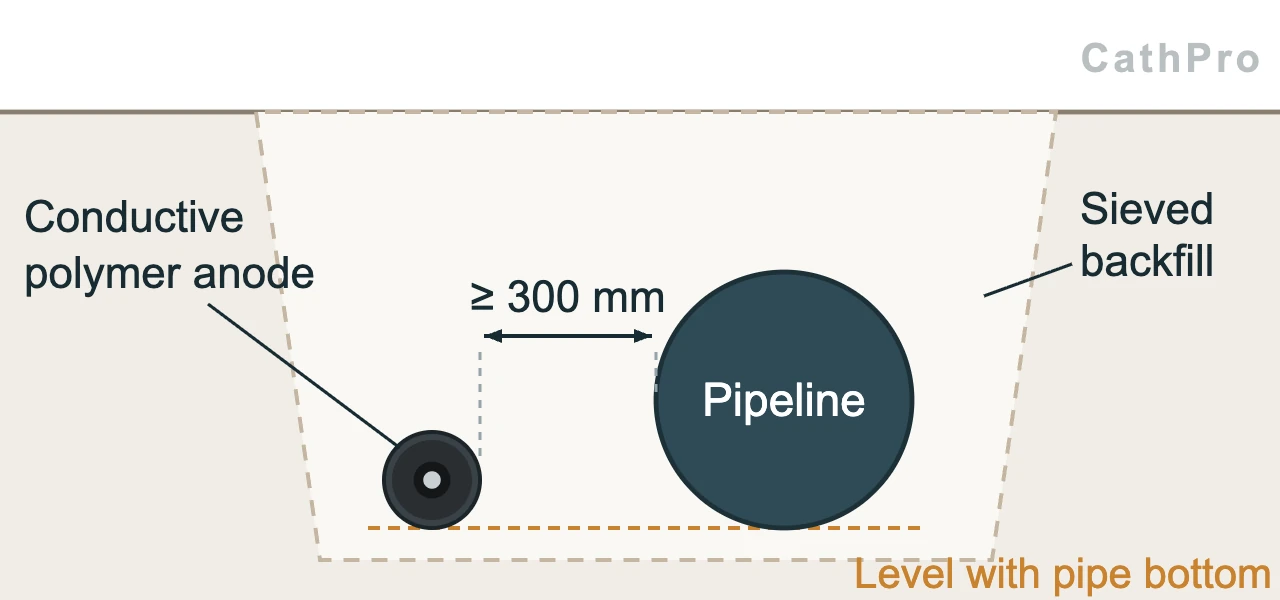
- Parallel to the pipeline, ≥ 300 mm and ≥ half the pipe diameter away, level with the pipe bottom
- No contact with buried metal; insulating sleeve where it crosses pipes, earth electrodes or other anodes
- Unreel by rotating the reel; never drag the anode
- Bending radius ≥ 150 mm bare, ≥ 500 mm pre-packaged; no kinks or twisting
- Do not install below −18 °C
- Keep the anode slack, with an allowance for settlement
- Directional drilling: bore parallel to the pipe at the design distance
- Backfill with sieved soil, compacted in layers
- Joints and end seals with the matching kits
- Lead cables to the rectifier positive via an anode junction box
Standards by scope
Use each reference only for the layer it controls.
CathPro data sheet CP-DS-PA-001 is the product specification. The references below control the conductor, the system design and the inspection documents.
| Reference | What it controls | Correct application |
|---|---|---|
| ISO 15589-1 | Cathodic protection of on-land pipeline systems. | System design, criteria and commissioning by the project engineer; not an anode product specification. |
| IEC 60228 | Conductors of insulated cables. | Size and class 2 stranding of the 16 mm² tinned copper conductor. |
| API RP 651 · AMPP SP0193 | Cathodic protection of above-ground storage-tank bottoms. | Tank-bottom application and design references; not product certification. |
| EN 10204 | Types of inspection documents. | Inspection certificate type 3.1 on request. |
Inspection and documents
Agree the evidence before manufacture.
Records are included as confirmed in the quotation and the project document register.
Every reel
Appearance, outer diameter, length and conductor continuity (DC resistance).
Packing check
Uniform coke packing, intact fabric jacket and braid.
Release documents
Certificate of conformity, inspection certificate (EN 10204 3.1 on request), reel length list and packing list.
Reel marking
Product name, size, length, batch number, production date and unreeling direction.
Witness inspection
Customer or third-party witness points by agreement, stated in the order.
Storage
Clean and dry or protected from moisture; keep the wrapping until installation.
Download the Conductive Polymer Linear Anode Data Sheet
Data sheet CP-DS-PA-001: construction, technical data, applications, comparison with the MMO/Ti anode, installation, inspection and ordering information. No form is required.
Technical questions
Turn a length-and-price request into a quoteable anode requirement.
These answers separate the anode product from the CP system design, the installation and the project documents.
How much current can the anode deliver?
The maximum output is 52 mA per metre without backfill and 82 mA per metre with coke backfill, as in the pre-packaged version, for a design life of 20 years. Operating above the maximum output shortens anode life.
Is it the same as an MMO/Ti flexible anode?
Both are flexible linear anodes for impressed current cathodic protection. They differ in the current-discharging element: carbon-loaded polymer over a copper conductor, with no nodes, against MMO-coated titanium wire connected to an internal cable at nodes. The MMO/Ti flexible anode offers higher ratings and longer design lives.
Where is it not recommended?
In oily wastewater or saline water. Where high current per metre or a design life beyond 20 years is required, choose an MMO/Ti flexible anode.
Can it be installed beside an existing pipeline without excavation?
Yes. It can be pulled into a horizontal directional drilling bore that runs parallel to the pipeline at the design distance. The anode must never touch the pipeline or other buried metal.
Which standards apply?
CathPro data sheet CP-DS-PA-001 is the product specification. The copper conductor follows IEC 60228, the CP system is designed to ISO 15589-1, and tank-bottom applications refer to API RP 651 and AMPP SP0193. Inspection documents follow EN 10204.
What information is needed for quotation?
Provide the route or tank plan and anode length, required current and design life, soil resistivity and chemistry, installation method (trench or directional drilling), reel lengths and accessories, lead cable requirements, quantity, destination and required inspection documents.
Technical RFQ
Send the inputs that set the anode duty.
Have a CP design, route drawing or owner specification? Send it. Still in design? Send the available route, current and soil data; we will identify the missing inputs.
- We check application fit and RFQ completeness.
- We confirm anode length, packaging and reel lengths against the current demand.
- We confirm accessories, lead cables, inspection scope and documents before quotation.